
A Structural Reset for Bone Health
From T-Score Medicine to Walled Gardens — and the Responsibility of Stewardship
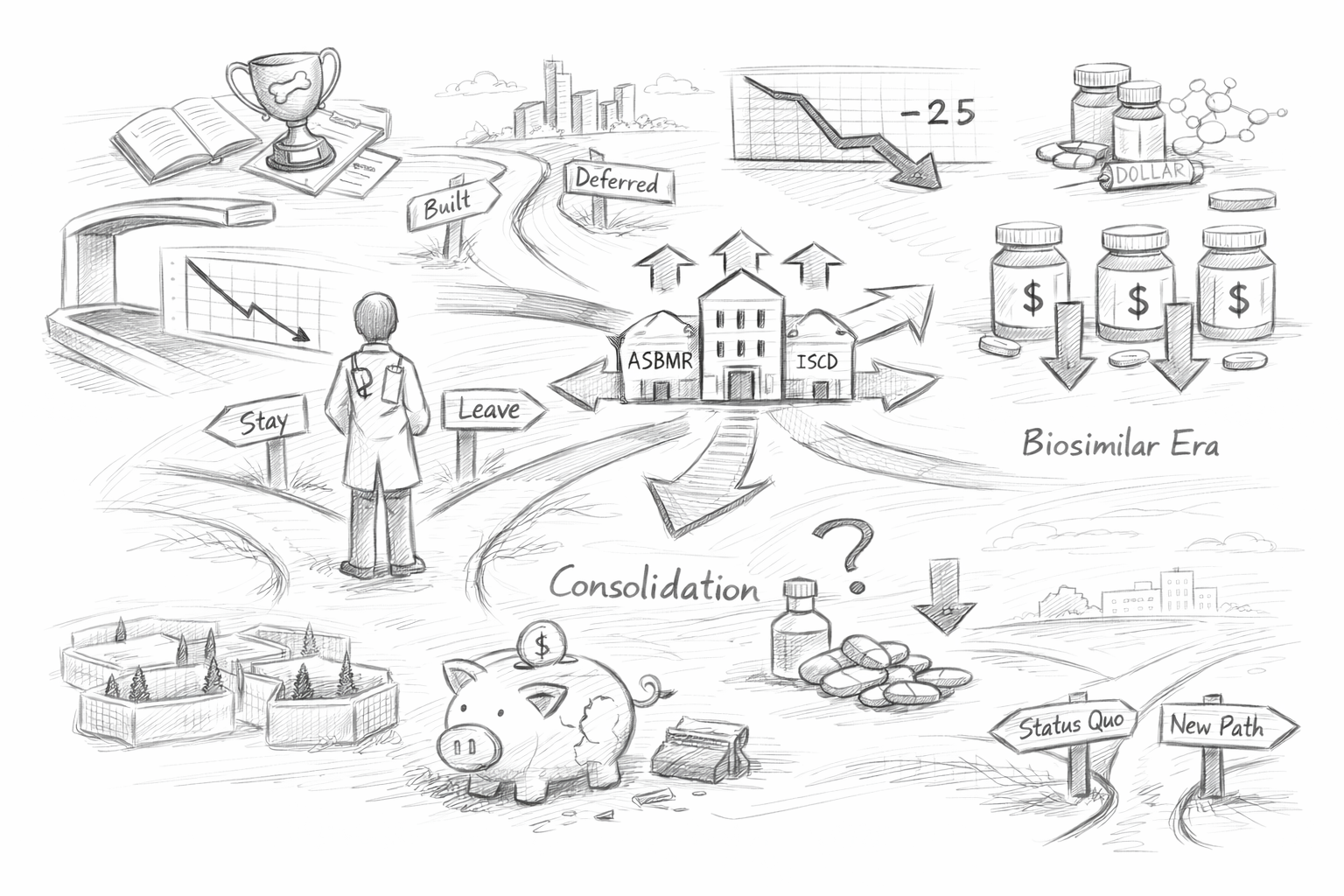
A Field That Succeeded
Bone health did not fail.
It succeeded.
Over the past four decades, osteoporosis moved from the margins of aging medicine into scientific legitimacy. Bone mineral density became measurable. Fragility fractures became preventable. Randomized trials demonstrated fracture reduction. Therapeutic innovation reshaped skeletal biology into actionable care [3–6].
That was not incremental progress. It was transformation.
But every transformative era eventually reaches maturity.
And maturity, if not intentionally redesigned, becomes stagnation.
The question facing bone health today is not whether osteoporosis is real, treatable, or important.
The question is whether the structure that carried the field through its expansion era is capable of carrying it forward.
The Measurement Revolution
The introduction of dual-energy X-ray absorptiometry (DXA) fundamentally altered skeletal medicine. For the first time, bone mineral density (BMD) could be quantified reproducibly, allowing skeletal fragility to move from abstraction to measurable reality.
The World Health Organization’s T-score framework provided diagnostic clarity and global standardization [1,2]. With a single metric, the field gained a common language. Osteoporosis could be defined, studied, reimbursed, regulated, and compared across borders.
Scientific leadership consolidated within the American Society for Bone and Mineral Research (ASBMR), while measurement and reporting standards were formalized by the International Society for Clinical Densitometry (ISCD). The institutional scaffolding of modern bone health took shape around this shared diagnostic architecture.
The T-score achieved several foundational outcomes. It defined osteoporosis as a disease entity rather than an inevitable consequence of aging. It enabled payer reimbursement by anchoring coverage decisions to quantifiable thresholds. It standardized clinical trials, allowing therapeutic efficacy to be tested in clearly defined populations. It provided regulators with measurable endpoints. And it created international consistency that accelerated scientific collaboration.
In short, the T-score built the field.
But it also embedded a structural logic: threshold medicine.
Once skeletal risk was reduced to a numerical cutoff, clinical decision-making organized itself around that boundary. Above −2.5, monitoring often prevailed. Below −2.5, treatment became justified.
Risk became binary. Imaging became gatekeeper. Eligibility defined intervention.
The T-score shaped not only diagnosis, but incentives — and those incentives would influence the architecture of bone health for decades.
The Pharmaceutical Vertical Era
The 1990s introduced bisphosphonates. Randomized trials demonstrated significant reductions in vertebral and non-vertebral fractures [3].
Osteoporosis became actionable.
Bisphosphonates inhibited osteoclast-mediated bone resorption. Later, denosumab refined antiresorptive targeting [4]. Anabolic therapies such as teriparatide and romosozumab demonstrated stimulation of bone formation and meaningful fracture reduction in high-risk populations [5,6].
Scientifically, this era was extraordinary.
Therapeutic architecture matured into antiresorptive stabilization, anabolic rebuilding, and sequential therapy strategies.
The nonprofit ecosystem expanded in parallel. The National Osteoporosis Foundation (NOF)— later evolving into the Bone Health and Osteoporosis Foundation (BHOF) — amplified advocacy and education. Own the Bone (AOA-OTB) strengthened post-fracture care. In recent years, American Society of Osteoporosis Providers (ASOP) supported community implementation, while National Spine Health Foundation (NSHF) connected skeletal fragility to broader musculoskeletal awareness.
Science, regulation, and industry sponsorship aligned.
For nearly two decades, the model thrived.
But it thrived because therapeutic expansion fueled it.
Infrastructure modernization remained secondary.
What Was Built — and What Was Deferred
The Pharmaceutical Vertical Era produced substantial and meaningful achievements. It generated sophisticated clinical guidelines, refined drug sequencing strategies, expanded educational symposia, strengthened secondary fracture programs, and supported the growth of large, well-designed clinical trial networks. These were not minor accomplishments. They professionalized the field and advanced patient care in measurable ways.
But what the era did not build is equally important.
It did not create interoperable national skeletal registries capable of tracking longitudinal outcomes at scale. It did not construct integrated musculoskeletal care platforms that aligned bone health with broader MSK strategy. It did not unify governance across the field’s major organizations. It did not aggregate capital reserves sufficient to fund modernization. And it did not meaningfully develop workforce pipelines designed to sustain generational renewal.
In other words, the ecosystem optimized for dissemination.
It did not optimize for integration.
As long as therapeutic growth continued, fragmentation was manageable. Expansion masked structural gaps.
When growth slowed, those gaps became visible. What had once appeared as distributed leadership began to resemble dispersion. What had once felt stable began to feel fragile.
The Inflection
Medicare reimbursement reductions for DXA produced measurable changes in screening patterns [7]. What followed was not dramatic collapse, but a quiet contraction. As screening declined, diagnosis declined. As diagnosis declined, treatment initiation declined.
The chain reaction exposed how tightly coupled the ecosystem had become to reimbursement mechanics.
At the same time, safety controversies and shifts in public perception further dampened therapeutic uptake [8,11,12]. Concerns about rare adverse events, amplified beyond their statistical frequency, influenced both patient and clinician behavior.
Importantly, the science did not deteriorate. The evidence base supporting fracture reduction remained intact.
What changed was structural resilience.
The system proved sensitive to financial and perception shocks. Its growth had been aligned closely with reimbursement and pharmaceutical economics, and when those variables shifted, there was little buffering capacity.
The ecosystem lacked structural redundancy. It had not built alternative pathways robust enough to absorb external stress without contraction.
The inflection was not scientific.
It was architectural.
Practice Sustainability
There is another layer beneath reimbursement shifts and workforce hesitation: practice sustainability.
Bone health, as currently configured, is economically fragile at the practice level.
DXA reimbursement volatility affects screening economics. Drug acquisition and site-of-care pressures complicate margin predictability. Prior authorization burden increases administrative overhead. Staffing requirements for longitudinal fracture management are rarely aligned with fee-for-service revenue.
In many settings, bone health is treated less as a growth engine and more as a compliance obligation or quality initiative.
Specialties expand when practices are financially durable. They attract trainees when clinical excellence aligns with operational sustainability. They build infrastructure when margins allow reinvestment.
When a service line is perceived as cognitively heavy, administratively complex, and financially thin, recruitment slows. Investment hesitates. Innovation migrates elsewhere.
This does not mean bone health cannot be economically viable.
It means that its current configuration makes sustainability uneven and fragile.
The field’s structural debate cannot ignore practice economics. Without financially durable delivery models, consolidation at the governance level will not be enough. Workforce formation will not be enough. Educational reform will not be enough.
Sustainable fields are built on sustainable practices.
Bone health must address that reality directly.
The Biosimilar Era
The entry of biosimilars marks a clear lifecycle transition.
In any mature therapeutic category, certain shifts reliably follow. Margins compress. Pricing power declines. Sponsorship growth slows. The strategic narrative moves from expansion to efficiency.
But maturity carries structural consequences. The financial dynamics that once underwrote educational growth, organizational expansion, and ecosystem momentum begin to tighten. What was once fueled by therapeutic innovation becomes governed by cost control and market stabilization.
If infrastructure modernization has not already occurred by the time biosimilars dominate, the field shifts from expansion to defense. Energy turns toward preservation rather than reinvention.
Bone health now stands at that juncture.
The Capital Problem
There is a structural issue underlying many of the dynamics described above.
Bone health, as currently organized, lacks access to meaningful scale capital.
During the Pharmaceutical Vertical Era, industry sponsorship functioned as a form of indirect financial support. Educational programming, meeting infrastructure, committee work, and quality initiatives were sustained by a sponsorship model tied to therapeutic growth.
That is not the same as capital formation.
Sponsorship supports operations.
Capital builds infrastructure.
Bone health has historically relied on meeting revenue, educational grants, restricted foundation funding, and modest operating reserves. What it has not developed is aggregated unrestricted capital capable of underwriting infrastructure modernization. There are no dedicated investment vehicles aligned to ecosystem redesign, no large-scale philanthropic capital pools tied to structural transformation, and limited engagement with private capital partners capable of funding integration.
As a result, the vertical operates with thin balance sheets relative to its clinical and economic importance.
When reimbursement shifts, there is limited buffer. When workforce contraction emerges, there is little funding for pipeline development. When interoperability or registry modernization is needed, there is no pooled capital base capable of underwriting transformation.
By contrast, adjacent healthcare sectors are capitalized differently. Integrated musculoskeletal platforms attract private equity and venture funding. Digital health infrastructure raises institutional capital. Health systems deploy strategic investment to align service lines and build data platforms.
Bone health, despite its scientific maturity and population impact, remains structurally undercapitalized.
It is a mature clinical field operating with early-stage nonprofit financial architecture.
That mismatch becomes more pronounced in a biosimilar era, where industry margins narrow and sponsorship becomes more constrained.
Without capital aggregation, consolidation becomes difficult.
Without consolidation, capital attraction remains unlikely.
This creates a structural loop: fragmentation prevents capital formation, lack of capital prevents modernization, and absence of modernization reinforces fragmentation.
Breaking that loop requires deliberate leadership.
The field cannot rely on therapeutic growth alone to fund its next phase.
It must address capital formation directly.
Walled Gardens
The nonprofit ecosystem that expanded during the growth years now resembles a series of walled gardens.
Not corrupt.
Not exclusionary by intent.
But structurally enclosed.
Within each garden, leadership tends to circulate within familiar professional networks. Governance structures prioritize continuity and stability. Annual meetings reinforce institutional identity. Sponsorship flows through established, predictable channels. Over time, these patterns create internal cohesion and cultural strength.
Each garden, on its own, is coherent and functional.
Collectively, however, they produce fragmentation at the ecosystem level.
Gardens are very good at preservation. They cultivate expertise, protect standards, and sustain community. But gardens are not designed to scale into integrated platforms. They protect what is inside their walls; they do not naturally build the connective infrastructure that spans beyond them.
In an expansion era, this structure worked.
In a maturity era, it constrains.
Circular Reinforcement and Structural Inertia
During expansion, reinforcing cycles sustained the ecosystem:
Therapeutic innovation → Sponsorship → Nonprofit growth → Education → Therapeutic uptake → Continued sponsorship
When expansion slows, instinct shifts to preservation:
Protect the meeting.
Protect the board.
Protect the donor base.
Protect institutional identity.
Preservation is rational institutionally.
At ecosystem level, it becomes inertia.
The Responsibility of the Generation That Built Bone Health
The leaders who built modern bone health advanced science, legitimized disease, and strengthened clinical care.
They deserve recognition.
But maturity introduces responsibility.
When a field transitions from expansion to consolidation, stewardship replaces growth as the primary obligation.
If consolidation does not occur voluntarily, it will occur externally.
Platforms will integrate what gardens preserve.
The generation that built bone health now holds the authority — and the responsibility — to ensure it evolves beyond them.
Workforce — The Signal of the Future
The clearest indicator of a field’s endurance is not reimbursement policy, drug pipelines, or annual meeting attendance.
It is workforce.
Persistent treatment gaps after fracture [8,11] already signal structural strain. At the same time, declining enthusiasm among early-career clinicians suggests a deeper concern about the field’s trajectory.
Within bone health, education is often cited as the primary solution to the treatment gap. But in practice, education frequently means additional continuing medical education layered onto heterogeneous training backgrounds.
CME maintains competence.
It does not create it.
In most mature specialties, foundational, standardized training establishes baseline competence. Lifelong CME then refines and updates that competence over time. The sequence matters.
Bone health has historically relied heavily on post-training education as an entry point. What it has not consistently built is a standardized baseline of fracture risk assessment and management competence across disciplines. The result is uneven preparation and variability in practice confidence.
If the next phase of bone health depends on earlier identification, longitudinal management, and integration within musculoskeletal systems, then workforce formation must begin before CME.
The field requires structured competence formation — embedded in fellowship pathways, residency exposure, and interdisciplinary training models — with CME serving as maintenance rather than substitution.
Without that shift, educational efforts will continue to address gaps episodically rather than structurally.
And when young physicians evaluate where to invest their careers, they do not simply assess scientific merit. They assess identity clarity, preparation pathways, and professional sustainability. If they see fragmented governance, administrative burden, weak economic signals, and limited infrastructure modernization, they draw conclusions.
Retraction in mature fields rarely occurs through dramatic collapse.
It occurs through migration.
And migration is already underway.
Consolidation as Stewardship
Part of the solution is not the creation of another nonprofit layered onto an already fragmented ecosystem.
It is the consolidation, in some form, of the existing leadership institutions that collectively define the field — the American Society for Bone and Mineral Research (ASBMR), the Bone Health and Osteoporosis Foundation (BHOF), the International Society for Clinical Densitometry (ISCD), the American Society of Osteoporosis Providers (ASOP), Own the Bone (AOA-OTB), and the National Spine Health Foundation (NSHF).
Fragmentation once reflected growth. Separate organizations emerged to advance research, advocacy, imaging standards, clinical implementation, and quality improvement. In an expansion era, differentiation made sense.
Now fragmentation reflects maturity.
In a mature field, dispersion of governance and capital limits scale. Separate boards, administrative infrastructures, and strategic agendas dilute leverage at precisely the moment integration is required.
Consolidation would not erase identity. It would align it. It would allow reserves to be pooled rather than siloed, reduce duplicative administrative overhead, strengthen unified strategy, enable meaningful infrastructure modernization, and send a clear signal to the next generation that this field intends to endure.
Consolidation is not an act of aggression toward history.
It is an act of stewardship toward the future.
The Choice
The T-score built the field.
Antiresorptives and anabolics strengthened it.
Secondary prevention stabilized it.
The biosimilar era signals structural maturity.
The science remains strong.
The structure must evolve.
Walled gardens preserve what was built.
Platforms build what comes next.
The responsibility now lies with those who built bone health to ensure it continues — not unchanged but strengthened for a different era.
Author’s Note
I am no longer involved in nonprofit leadership or organizational work within legacy bone health. I do not represent any society, foundation, or advocacy group. This piece reflects my own analysis after eight years inside the field.
Pete
Ptbianco@me.com
References
1. Kanis JA, Melton LJ III, Christiansen C, Johnston CC, Khaltaev N. The diagnosis of osteoporosis. J Bone Miner Res. 1994;9:1137-1141.
2. Kanis JA et al. Assessment of fracture risk and its application to screening for postmenopausal osteoporosis. WHO Technical Report Series 843. 1994.
3. Black DM et al. Randomised trial of alendronate on fracture risk. Lancet. 1996;348:1535-1541.
4. Cummings SR et al. Denosumab for prevention of fractures in postmenopausal women. N Engl J Med. 2009;361:756-765.
5. Neer RM et al. Effect of parathyroid hormone (1-34) on fractures and bone mineral density. N Engl J Med. 2001;344:1434-1441.
6. Cosman F et al. Romosozumab treatment in postmenopausal women with osteoporosis. N Engl J Med. 2016;375:1532-1543.
7. Curtis JR et al. The impact of reimbursement changes on DXA utilization. J Bone Miner Res. 2010;25:2469-2474.
8. Solomon DH et al. Osteoporosis medication use after hip fracture. Arch Intern Med. 2003; subsequent analyses JBMR/JAMA.
9. Lewiecki EM et al. Best practices for DXA measurement and reporting. J Clin Densitom. 2016.
10. Dell R et al. The fracture liaison service model. J Bone Joint Surg Am. 2008;90(Suppl 4):188-194.
11. Khosla S, Shane E. A crisis in the treatment of osteoporosis. J Bone Miner Res. 2016;31:1485-1487.
12. Adler RA et al. Managing osteoporosis in patients on long-term bisphosphonate treatment. J Bone Miner Res. 2016.
